Tracking your spending is only half the job. The other half is looking at it. Data that sits in an app unread doesn’t change anything; a few minutes of reflection each month can change a lot.
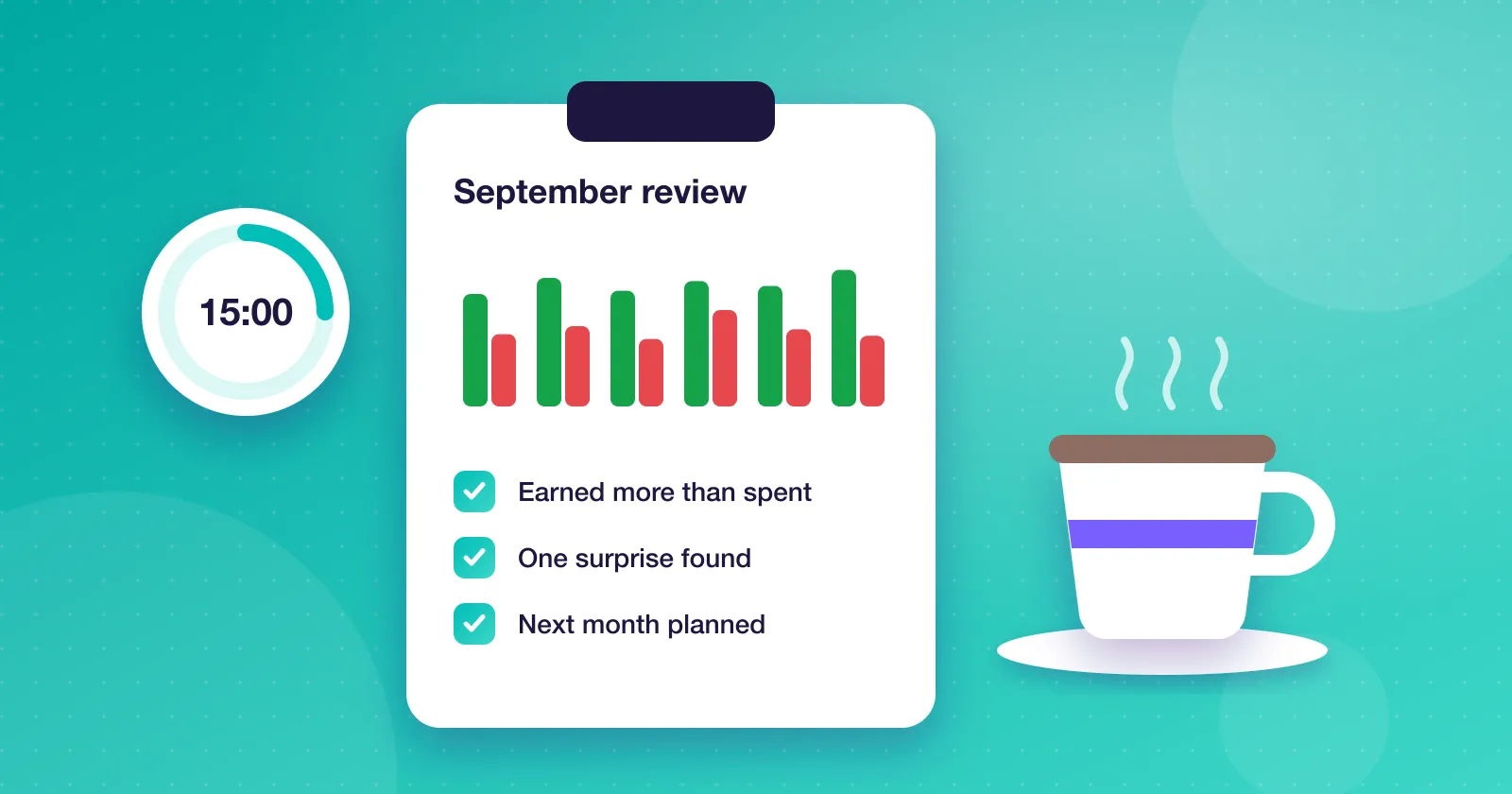
The good news is that a useful money review doesn’t take an afternoon. Here’s a routine that takes about fifteen minutes, ideally right after your budget month ends. If your month starts on payday, do it the day before your next paycheck arrives.
Make a coffee. Open your tracker. Let’s go.
Minute 0–3: Check the record is complete
Before you draw any conclusions, make sure the data is right.
- Scroll through the month’s history. Anything obviously missing, like rent, a bill or a big purchase?
- Compare your account balances in the app with your real bank balance. If they’re off, find the missing transaction.
- Fix anything with the wrong category.
This doesn’t have to be perfect. You’re aiming for “close enough to trust”.
Minute 3–6: Look at the big picture
Now answer three questions:
- Did I spend less than I earned? This is the single most important number. If income minus spending is positive, you’re moving forward.
- How does this month compare with the last few? A trend chart is ideal. One unusual month is noise; three in a row is a pattern.
- What was my daily average spend? Oddly, this is one of the most intuitive numbers. “I spend about $85 a day” is easier to feel than a monthly total.
In Expense Manager, the Reports screen shows all of this at a glance: spending by category, a six-period income-vs-expense trend, your daily average, and your top category.
Minute 6–10: Find the surprises
Look at your spending by category. You’re hunting for surprises, not failures:
- Which category was bigger than you expected?
- Tap into it. What made it big? A single large purchase, or lots of small ones?
- Did any budget go over? Was it a one-off, or does that budget need to be more realistic?
Pick one insight to carry forward. Just one. Trying to fix everything at once is how good intentions evaporate.
Minute 10–13: Plan next month
Look ahead:
- Known irregular costs. Birthdays, annual renewals, car service, a trip. Anything coming next month that isn’t normally there?
- Adjust budgets. If a category was unrealistic, change it. If next month is unusual, override just that month’s budget rather than your usual one.
- Check recurring entries. Any new subscriptions to add? Any cancelled ones to remove?
Minute 13–15: Celebrate something
Seriously. Find one thing that went well: a category you stayed under, a savings transfer you made, a month where you logged everything. Money habits are built on momentum, and momentum needs wins.
A simple template
If it helps, jot your answers down somewhere, like a notes app or a simple text file:
Month: September Earned vs spent: +$420 Biggest surprise: Eating out was $310, mostly weekday lunches One change for next month: Bring lunch two days a week Coming up: Car insurance renewal, two birthdays Win: Stayed under the grocery budget for the first time
Twelve of these, one a month, give you a remarkably clear picture of your year.
Making the habit stick
- Put it in your calendar as a recurring event, just like any other appointment.
- Keep it short. Fifteen minutes is the point. If it turns into two hours, you’ll stop doing it.
- Do it even in bad months. Those are the months when the review is most valuable.
- Make it pleasant. Good coffee, a comfortable chair, maybe a treat. Don’t make it a punishment.
The bottom line
The monthly review is where tracking turns into progress. Fifteen minutes, once a month: check the record, look at the big picture, find one surprise, plan ahead, and celebrate a win. It’s a small ritual that compounds over time.